BEARING DATA
Search Boundary Dimensions and Bearing Numbers
Types of Bearing


Tapered Roller Bearings
Tapered roller bearings are designed to carry combined radial and axial loads. Their tapered rollers and raceways allow the load to be distributed efficiently, which is why they are widely used in wheel hubs, gearboxes, and other heavy-duty rotating assemblies.
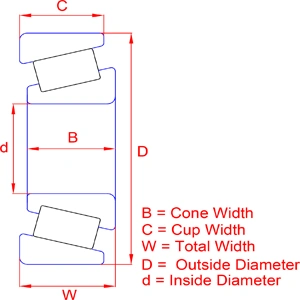
This page helps you identify tapered roller bearings by number or by key dimensions such as inside diameter, outside diameter, width, cone width, and cup width. It also explains the cone and cup relationship, so replacement and verification become easier during maintenance work.

Why Tapered Roller Bearings Are Different
Tapered roller bearings are different from ball bearings because their rolling elements are conical rather than spherical. That shape allows the bearing to carry combined radial and axial loads at the same time. The inner ring is commonly called the cone, and the outer ring is called the cup.
How the Cone and Cup Work Together
The cone contains the inner race and tapered rollers, while the cup provides the outer raceway. When the bearing is loaded, the tapered geometry guides the rollers into the raceways and helps distribute force over a larger contact area. This is one reason tapered roller bearings are widely used where load direction changes during service.
Typical Applications
- Automotive wheel hubs
- Transmissions and gearboxes
- Industrial reducers
- Heavy equipment axles
- Machine tool and rotating assemblies
Comparison With Related Bearing Types
| Bearing Type | Best Load Style | Typical Strength | Common Use |
|---|---|---|---|
| Tapered Roller Bearing | Combined radial and axial load | High load support and alignment stability | Hubs, gearboxes, heavy machinery |
| Deep Groove Ball Bearing | Mainly radial load | Simple and versatile design | Motors, general machinery |
| Cylindrical Roller Bearing | High radial load | Good radial capacity and stiffness | Gearboxes, motors, machine tools |
How to Use This Page
Start with the bearing number if it is visible. If the number is missing or damaged, measure the bore diameter, outside diameter, total width, cone width, and cup width to narrow down the correct bearing. That makes replacement work faster and reduces the chance of ordering the wrong part.
Reliability Note
The search tools on Engineer Data Hub are built around standard bearing dimensions used in workshop and catalog lookup work. This helps users compare actual measurements with commonly used bearing sizes in a practical way.


Engineer Data application provides a comprehensive suite of engineering calculations, including:
• Spur Gear Cutting Calculation on Milling Machine
• Helical Gear Cutting Calculation on Milling Machine
• Worm and Worm Gear Cutting Calculation on Milling Machine
• Gear Train Calculation for Helical Gear Cutting on Milling Machine
• Simple Indexing for Milling Machine
• Gear Train Calculation of Differential Indexing for Milling Machine
• Taper Calculation for Lathe Machine Jobs
• Hole Dividing Calculation for Drill Machine
• Bearing Number Identification and search of boundary dimension
Improve your engineering projects with accurate and reliable data. For more information visit Engineer Data Hub