

What a Thrust Ball Bearing Does
A thrust ball bearing is built to carry axial force only, or mainly axial force, depending on the design. It is not a radial load bearing in the same way a deep groove ball bearing is, so it should be selected for jobs where end thrust is the main concern. This makes it a good fit for assemblies such as screw jacks, rotary tables, turntables, vertical shafts, and thrust-loaded machine parts.
Main Features
1. Axial-load design: The bearing is made to resist force parallel to the shaft axis.
2. Washer arrangement: A shaft washer, housing washer, and ball cage work together to carry thrust.
3. Low-friction rolling action: Balls reduce sliding friction and help the part rotate smoothly.
4. Single-direction or double-direction styles: Some designs carry thrust in one direction, while others can handle thrust from both sides.
5. Best for controlled rotation: They are often used in slow to moderate speed equipment where thrust load is the main factor.
Comparison Table
| Bearing Type | Main Load | Radial Load Support | Typical Use |
|---|---|---|---|
| Thrust Ball Bearing | Axial | Very Low | Screw jacks, turntables, vertical thrust support |
| Deep Groove Ball Bearing | Radial + light axial | High | General-purpose rotating machines |
| Cylindrical Roller Bearing | High radial | High radial / limited axial | Gearboxes, motors, machine tools |
Use-Case Notes
Choose a thrust ball bearing when the application needs end-thrust support and the radial load is small. If the shaft is also carrying strong radial load, another bearing type may be more suitable. For example, a vertical screw jack may use thrust support at one end, while a motor shaft usually needs a radial bearing instead.
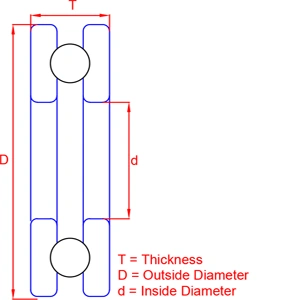
In maintenance work, the bearing number is the fastest way to identify the replacement part. If the number is missing, the bore diameter, outside diameter, and width can still help you locate the correct bearing in the catalog.
When to Use This Page
Use this page when you need to search a thrust ball bearing by number or dimensions, verify a replacement part, or compare it with another bearing type before installation. This is especially useful for engineering, workshop, and repair jobs where dimensional match and load direction both matter.